|
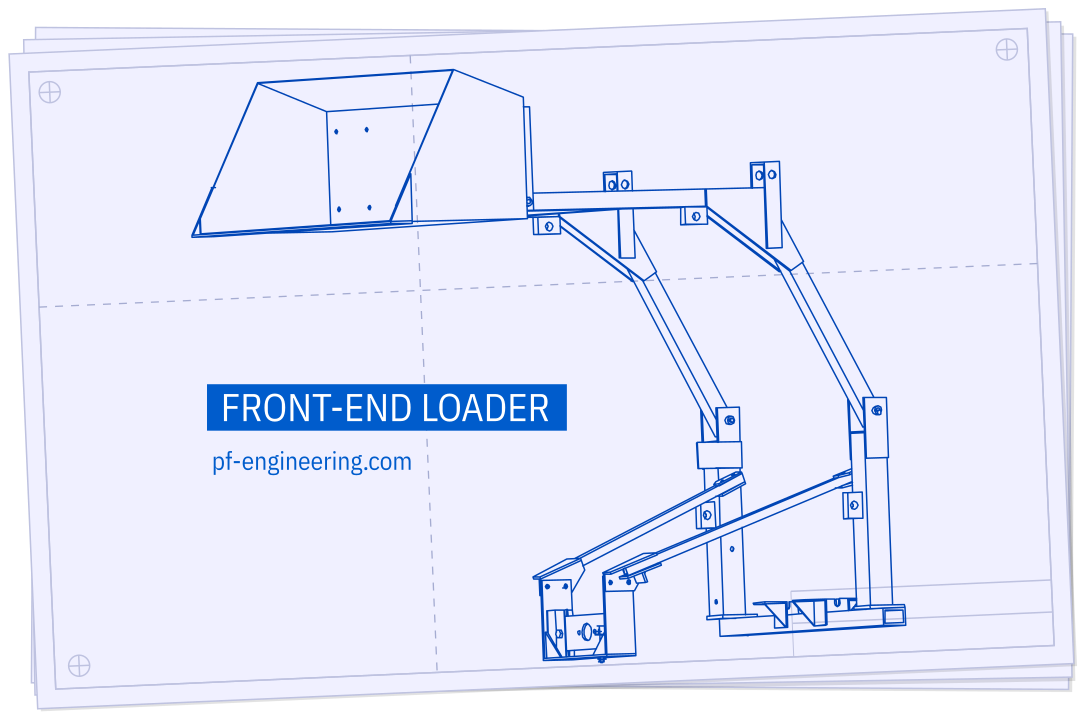
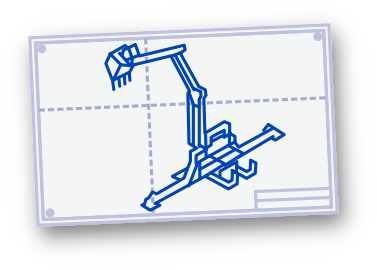
this site is dedicated to our Front End Loader CAD plans designed for use on
Garden Tractors and Compact Tractors.
Please feel free to browse our other sites:
http://www.backhoeplans.com
http://www.p.f.engineering.50megs.com
http://www.loaderandbackhoepics.50megs.com
http://www.loaderandbackhoepics2.50megs.com
http://www.loaderandbackhoepics3.50megs.com
http://www.loaderandbackhoepics4.50megs.com
http://www.loaderandbackhoepics5.50megs.com
for more information on our designs.
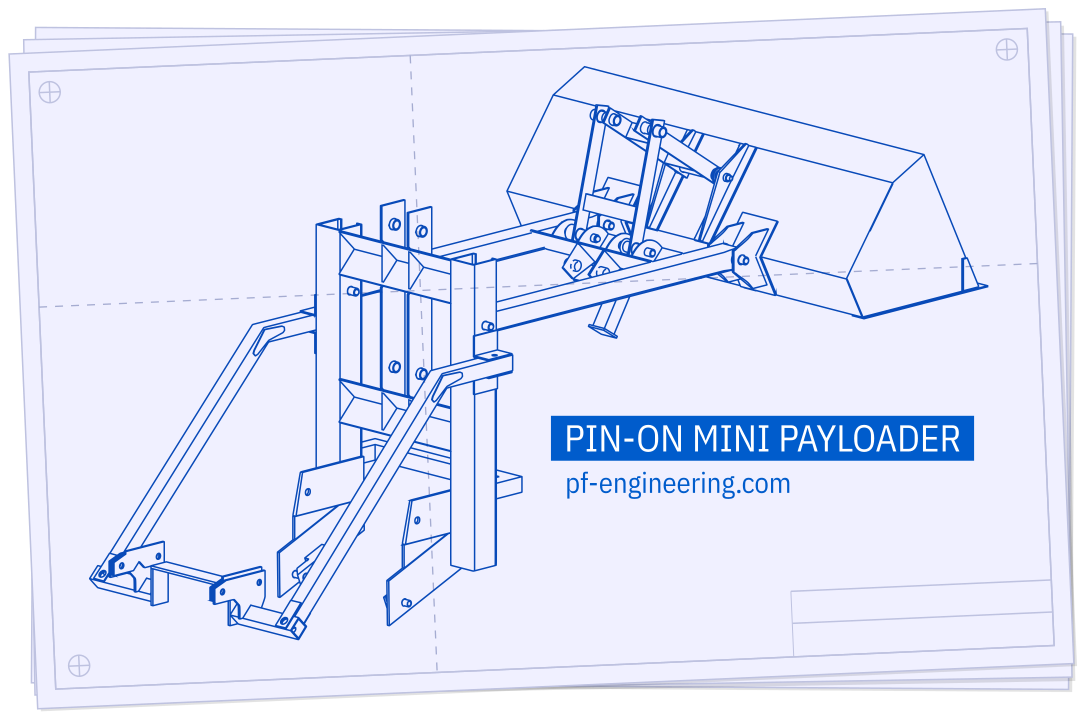
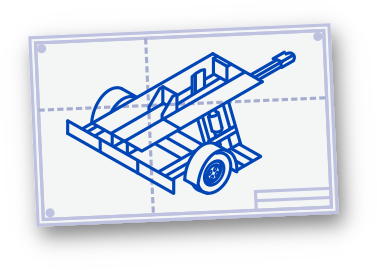
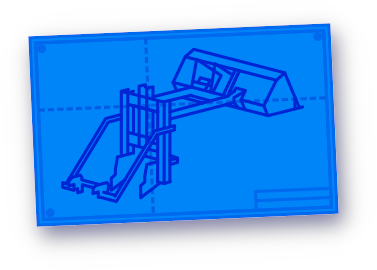
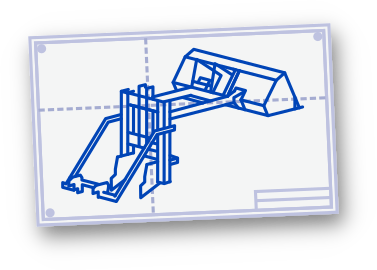
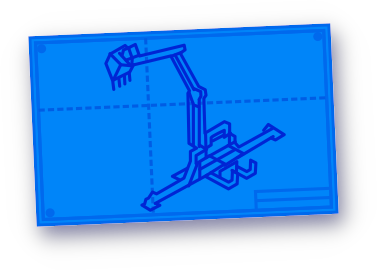
if you are interested in building a Front End Loader for your small tractor you've come
to the right place. our plans will guide you through the build process with detailed
diagrams, complete bill of materials pages, hydraulic schematics and construction notes.

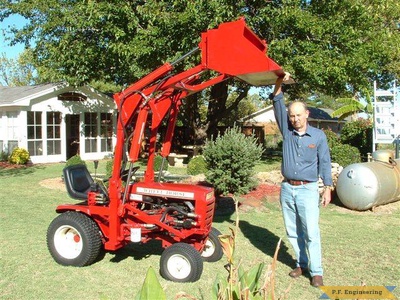
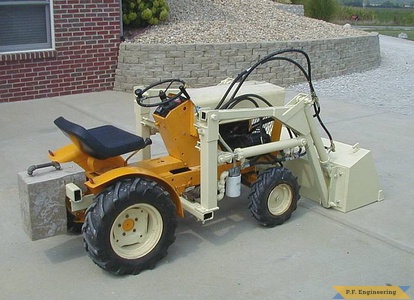
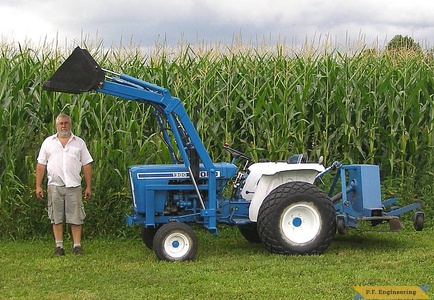
this is our prototype loader on a Cub Cadet model 149 with 14HP kohler engine,
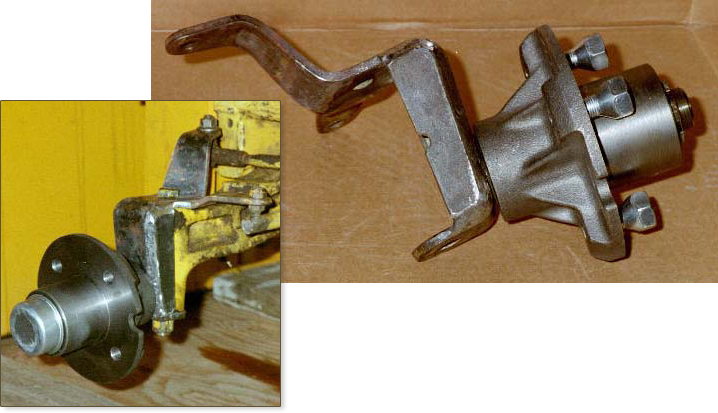
hydrostatic trans and upgraded front spindles (see our spindle upgrade page)
it has a separate hydraulic pump belt driven from the front engine PTO for the loader
hydraulics.
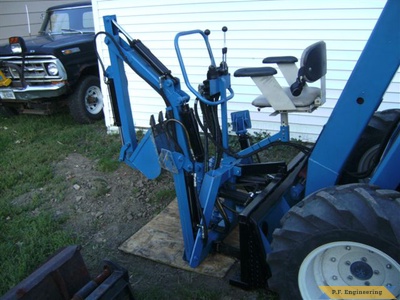
here is one of our loaders on a Ford 1110 compact diesel 4WD with a fork lift attachment

check out our current ads in the following publications:
Red Power Magazine http://www.redpowermagazine.com
Cadet Connection newsletter http://www.cadetconnection.com
Farm Show Magazine of Lakeville, Minn.
see our article in the January 2006 edition http://www.farmshow.com
Farm Collector Magazine http://www.FarmCollector.com
starting June 2006
Frequently Asked Questions
Q. how much does it cost to build one of these Front End Loaders?
A.figure around $1000 to $1200 complete for steel and all hydraulics, a little less if you can use your tractor's on-board
figure around $1000 to $1200 complete for steel and all hydraulics, a little less if you can use your tractor's on-board
hydraulic system to power the unit, and even less if your tractor has dash mounted control levers as some garden tractors do.
buying local steel should cost you close to $300 and the remaining cost would be in hydraulics and for having parts shipped in.
Q. how much hydraulic flow (GPM) and PSI is required to run this Loader?
A. the Loader can be run with as little as 2 or 3 Gallons Per Minute hydraulic flow and with as low as 750 PSI.
the Loader can be run with as little as 2 or 3 Gallons Per Minute hydraulic flow and with as low as 750 PSI.
for tractors with low GPM on-board hydraulic capabilities we suggest using 1.5" bore hydraulic cylnders to maintain good operating
speed, but if your tractor generates 4 GPM or more on-board you can go with the more economical 2" bore hydraulic cylinders.
for tractors without on-board hydraulics, the most economical way to go would be to belt drive a 4 to 8 GPM hydraulic pump from
the same pulley that runs your mower deck and use the 2" bore hydraulic cylinders
Q. how much can this loader lift?
A. this front end loader can easily lift 500 lbs and more if your tractor has sufficient vehicle weight to offset the weight on the front
end. a pair of 2" bore cylinders running at 1000 PSI system pressure can easily lift in excess of 1000 lbs and likewise a pair of 1.5" bore
hydraulic cylinders @ 1000 PSI system pressure will lift as much as a garden tractor can safely handle and then some. the hydraulic
system i spec in the plans is overkill for a garden tractor and very sufficient for compact 4WD diesel tractors. smaller tractors have the
option of running a lower system pressure with the 2" bore cylinders and extending the life of their hydraulic components while still being
able to lift as much as safe operation allows.
Q. do i need any special tools to build the Front End Loader?
A. not really, i was able to build my prototype loader (above top) with what i consider basic tools. for cutting steel i had a
Makita 10" chop saw with composite metal cutting blade and a sawzall. my drilling was done with a small bench top drill
press and bi-metal hole saws. my welder is a Lincoln SP-100T, 100 amp wire feed mig using .035" flux core wire, running on
a dedicated 20 amp household circuit. i would suggest having a bench grinder, disk grinder, assorted clamps, bench vise, etc.
just the basic stuff for garage steel fabrication projects.
Q. how long does it take to build one of these Front End Loaders?
A. this would depend on your steel fabrication skills, however an average mechanically inclined person with basic tools and all
this would depend on your steel fabrication skills, however an average mechanically inclined person with basic tools and all
the necessary materials on hand should be able to construct one of these loaders in 4 weeks of spare time evenings and weekends.
i've noticed that when you have one of these projects on the bench, you seem to suddenly find more spare time than you thought
you had! i have had one customer build the loader in one weekend, others take less than a month, and some quite a bit longer.
my original Loader took me a few months of spare time, but that was designing, searching for suppliers, purchasing parts, working
out conflicts, building, testing, etc, etc.
Q. will this Loader fit my tractor? how does it attach to my tractor?
A. the Loader can be mounted on any tractor that has a strong enough frame and front end to handle the weight. we suggest
the Loader can be mounted on any tractor that has a strong enough frame and front end to handle the weight. we suggest
using a tractor with at least a 1/8" thick twin rail frame running the length of the tractor, a cast iron front axle with
minimum 3/4" front spindles and greasable bearings in the front rims. for engine HP we suggest 10 or 12 HP and up. hydrostatic
transmissions are preferred because they transfer the power more smoothly to the ground which saves stress on major drive line
components when compared to a gear and clutch drive.
the attachment system is made up of a simple sub frame member that runs across under your tractors frame and bolts to the
underside of the frame. this provides the foundation for your tower uprights. the towers are stabilized by a diagonal brace running
down to the nose of your tractor. this brace is the most important component of the design since it transfers the weight of the bucket
to the front of your tractor and is responsible for taking the brunt of the forces when you are pushing the bucket into a pile of material,
digging below grade or back dragging with the loader bucket. we provide an example for mounting the pump under a front engine
PTO pulley, with belt tension adjustment. this mounting design can be adjusted according to your available PTO pulley location.
Q. i am not able to weld or build one of these Front End Loaders myself. how can i get one for my tractor?
A. there are a few ways to accomplish this. the most expensive would be to take our plans to a welding shop and have it built,
however there are less expensive alternatives to this. we suggest looking into the vocational schools or community colleges
in your area to find out if they have any steel fabrication or welding courses available. usually the instructors of these classes
would welcome the thought of someone with well drawn CAD plans offering to sponsor the class with a welding project of this
type. you would pay for all of the steel and hydraulics required and they would provide the labor to cut and weld it all together,
free of charge.
this benefits all parties involved, the students are given the experience of working with CAD plans, steel and hydraulics,
the school system benefits by having someone sponsor the project and of course, you benefit by getting to keep the
Front End Loader when they are finished!
More FAQ to come......
we invite you to have a look around, check out some of our customers machines and
compare our design specifications and pricing to other offerings you may have seen
on the web.
thanks for stopping by!
P.F. Engineering
47 Pomeroy Lane
Amherst, MA 01002-2905
(413) 256-4960
Questions? email us at:
info@Loaderplans.com
|